 11, Nov
How Does Cloud Mining Work?
How Does Cloud Mining Work? A Beginner’s Guide
Cloud mining has made cryptocurrency mining easier to understand and access for people who are interested in the technology but do not want to purchase and operate mining hardware themselves. Instead of setting up specialized machines at home, cloud mining allows users to access computing resources operated remotely by a mining provider.
But what actually happens behind the scenes? How does a cloud mining platform connect users with mining infrastructure, and what role do computing power, mining hardware, and blockchain networks play?
Let’s take a closer look at how cloud mining works.
Understanding Cryptocurrency Mining
Before understanding cloud mining, it is important to understand cryptocurrency mining itself.
Some cryptocurrencies use a system called Proof of Work, where specialized computers perform computational work to help process transactions and maintain the blockchain network.
Mining machines continuously perform calculations according to the rules of the particular blockchain. Miners compete to find valid solutions, and successful mining activity can result in cryptocurrency rewards according to the network protocol.
This process requires significant computing resources. Professional mining operations also need electricity, cooling systems, internet connectivity, specialized hardware, software, and ongoing maintenance.
Traditional cryptocurrency mining means that the individual miner is responsible for these resources.
Cloud mining takes a different approach.
What Is Cloud Mining?
Cloud mining is a model in which customers access cryptocurrency-mining computing power that is hosted and operated remotely.
Instead of buying mining machines, installing them, connecting them to electricity, managing their temperature, and maintaining the equipment, a customer can use an online platform to access mining capacity provided by a remote operation.
The physical machines remain at the provider's facility, while the customer interacts with the service through an online account or dashboard.
In simple terms:
Traditional Mining:
You own and operate the mining hardware.
Cloud Mining:
A provider operates the infrastructure and you access the available mining service remotely.
The exact structure can differ from one provider to another, so it is important for users to understand the terms and conditions of the specific service they are considering.
How Does Cloud Mining Actually Work?
The cloud mining process can be understood by looking at what happens from the mining facility to the customer's account.
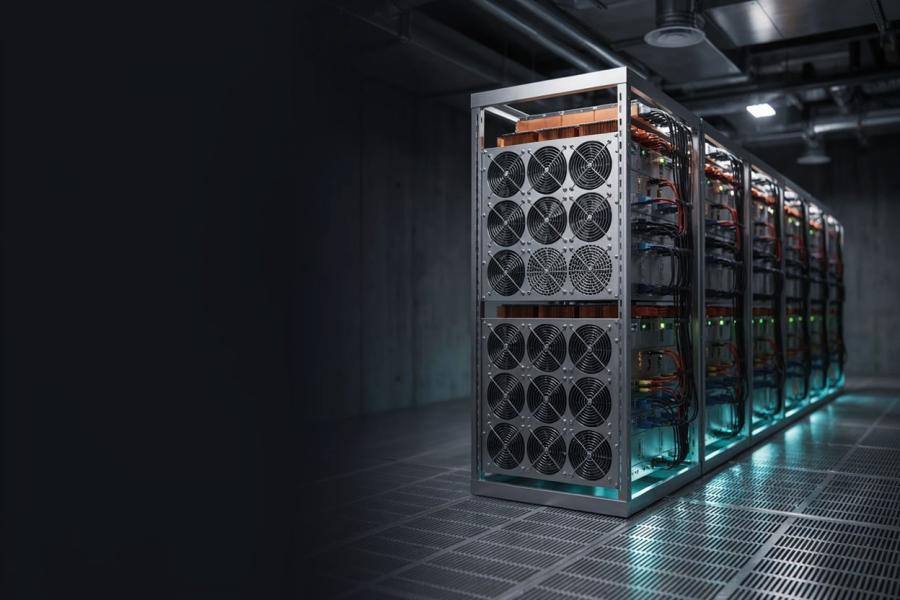
First, a mining provider establishes physical infrastructure containing specialized cryptocurrency-mining machines. These machines are connected to power, cooling, networking, and mining software.
The equipment then contributes computing power to a blockchain network, often through a mining pool.
The provider can make a portion of its available computing capacity accessible to customers through a cloud-mining service.
When a customer purchases or obtains access to a specific amount of computing power, the platform records that allocation and uses it as part of the service's mining calculation.
The customer does not normally need to physically interact with the mining machines.
Instead, information about the service may be displayed through an online dashboard.
The Role of Hashrate
One of the most important terms in cloud mining is hashrate.
Hashrate refers to the amount of computational work that mining equipment can perform over a period of time.
It is commonly measured using units such as TH/s, PH/s, or EH/s, depending on the scale of the mining operation.
A higher hashrate represents more computing capacity. However, it does not automatically mean a guaranteed profit.
Mining is competitive, and the overall network environment changes continuously. The amount of computing power participating in a blockchain can increase or decrease, while mining difficulty can also change.
For this reason, hashrate should be understood as a measurement of computing capacity rather than a promise of a particular financial result.
Where Do Mining Rewards Come From?
A common question beginners ask is where the cryptocurrency received through mining actually comes from.
In a Proof-of-Work blockchain, mining rewards are generated according to the rules of the network.
Mining machines contribute computational work to the blockchain. When a miner or mining pool successfully completes the required process and adds a valid block, the network protocol determines the applicable reward.
A cloud-mining provider may operate this mining infrastructure on behalf of customers and account for their allocated computing power according to the service agreement.
The final amount associated with a customer's account can depend on several factors, including mining performance, network difficulty, pool arrangements, fees, and the specific terms of the service.
The Role of Mining Pools
Mining cryptocurrency independently can be difficult because individual machines may have relatively little computing power compared with large professional operations.
This is why many miners participate in mining pools.
A mining pool combines computing power from multiple participants. The pool works collectively on mining activity, and eligible rewards are distributed according to the pool's rules.
Cloud-mining providers may connect their infrastructure to mining pools as part of their operations.
For customers, this process is usually handled in the background. They can interact with the cloud-mining platform without needing to configure mining software or manage the physical machines themselves.
Why Is Physical Infrastructure Important?
Although cloud mining is accessed online, the underlying mining process still depends on physical infrastructure.
Mining machines require electricity to operate and generate heat while running. Large-scale facilities therefore require appropriate cooling systems, power infrastructure, network connections, monitoring systems, and maintenance.
Professional mining facilities may operate large numbers of machines simultaneously.
This infrastructure is one of the main differences between simply owning cryptocurrency and participating in cryptocurrency mining.
Cloud mining provides remote access to a service that depends on this physical infrastructure.
What Are Mining Fees?
Cloud mining services can involve different costs depending on their business model.
These may include service fees, maintenance charges, electricity-related expenses, pool fees, withdrawal fees, or other platform charges.
Understanding these costs is important because the amount of cryptocurrency generated through mining is not necessarily the same as the final amount available to a customer.
For example, mining operations have real expenses associated with electricity, hardware, cooling, maintenance, facility management, and networking.
A responsible user should therefore review the complete fee structure before using a cloud-mining service.
What Can Affect Cloud Mining Results?
Mining performance can change over time because several factors influence the economics and output of mining.
Network difficulty can change the amount of computational work required by miners.
Network hashrate can change as more or fewer miners participate.
Hardware efficiency can influence the amount of computing power produced relative to electricity consumption.
Electricity and operating costs can affect the economics of the underlying mining operation.
Cryptocurrency market prices can also change significantly, meaning the market value of mined cryptocurrency can rise or fall.
These factors mean that mining results should never be treated as permanently fixed.
Cloud Mining vs. Mining at Home
One of the biggest advantages of cloud mining is convenience.
A person operating mining equipment at home may have to deal with hardware purchases, electricity consumption, heat, noise, internet connectivity, software configuration, maintenance, and equipment failures.
Cloud mining moves much of that responsibility to the provider.
The customer can interact with the service remotely rather than physically managing the machines.
However, this also introduces an important consideration: provider risk.
When using a cloud-mining service, customers depend on the provider to operate the underlying infrastructure and deliver the service according to its stated terms.
That makes transparency extremely important.
What Should Beginners Look For?
Anyone considering a cloud-mining service should take time to understand exactly what they are purchasing.
Look for clear information about the mining model, available computing power, contract duration, fees, maintenance arrangements, withdrawal conditions, and the infrastructure supporting the service.
It is also important to understand that cryptocurrency mining involves uncertainty.
A professional-looking website alone does not prove that a mining operation is legitimate or financially viable.
Users should review the available information carefully, understand the risks, and avoid assuming that past results will automatically continue in the future.
Why Understanding Cloud Mining Matters
Cloud mining can appear simple from the customer's perspective.
A user signs into a platform, selects a service, and monitors mining activity through an online dashboard.
Behind that simple interface, however, is a complex system involving hardware, electricity, cooling, software, networking, blockchain protocols, mining pools, and operational management.
Understanding these components helps beginners distinguish between the online interface and the actual technology that makes cryptocurrency mining possible.
The more users understand about the process, the better prepared they are to evaluate the services available to them.
Final Thoughts
Cloud mining works by providing remote access to cryptocurrency-mining computing resources operated by a mining provider.
Instead of purchasing and maintaining physical mining machines themselves, users can access mining capacity through an online platform while the underlying infrastructure remains at a remote facility.
The process still depends on real computing power, mining hardware, electricity, network conditions, mining difficulty, fees, and cryptocurrency market conditions.
For anyone new to cloud mining, understanding these fundamentals is an important first step.
Cloud mining is not a guaranteed source of income, and cryptocurrency-related services can involve significant technical, operational, market, and provider risks. Learning how the underlying technology works allows users to make more informed decisions and better understand what they are actually paying for when they use a cloud-mining service.
Share On
Latest Blog

Cloud Mining FAQ: 15 Questions Beginners...
11 November, 2022
How to Start With Cloud Mining: A Beginn...
11 November, 2022
Crypto Mining Risks: What Every Beginner...
11 November, 2022
Understanding Hashrate, Mining Difficult...
11 November, 2022